Showing posts with label 3DS. Show all posts

Thursday, 28 August 2014

No Objection to Professor Layton vs. Phoenix Wright Arriving Stateside

Professor Layton vs Phoenix Wright Cover

Fans of both the Professor Layton and Phoenix Wright franchises have been waiting a long time to see Professor Layton vs. Phoenix Wright: Ace Attorney hit the North American Market, and tomorrow their long wait is over. Combining the point-and-click adventure and puzzle solving of Professor Layton with the visual novel storytelling and courtroom drama of Phoenix Wright, this collaboration between Capcom and Level-5 marks the first time these two studios have ever worked together. The game's original story is written by Phoenix Wright series designer Shu Takumi, and makes use of the beautiful hand-drawn backdrops of the Professor Layton series, as well as the 3D graphics that were present in Phoenix Wright's latest 3DS outing, Dual Destinies. The game also includes anime cutscenes from the Bones animation studio.

The story begins in London, where Professor Layton and his assistant Luke are assisting Espella, a young woman being assaulted by mysterious forces, and encounter a magical book that transports them to a strange medieval city named Labyrinthia. Phoenix Wright and his assistant Maya Fey, in London on business, find the same book and are similarly transported. The four heroes have to combine their talents to solve the mysteries surrounding Labyrinthia, while also defending Espella in court as she is accused of witchcraft.

Professor Layton vs Phoenix Wright screen
It is a real treat to see Wright and Layton encroaching upon each other's territories, both being very intelligent (and somewhat arrogant) heroes in their own right. Players unfamiliar with the one or both of the franchises will get a crash course in lateral thinking as they are required to use their stylus to engage with townsfolk, find clues and solve all manner of puzzles (Professor Layton's forte), while also being tasked with rooting out contradictions in courtroom testimony, and presenting evidence at the right time to catch your witnesses off guard and expose their lies (the dominion of Phoenix Wright). Fans of one franchise or the other should find the gameplay stimulating, and those who are fans of both already are in for a real treat as we see Layton and Wright go tête-à-tête, and use their unique abilities to work out the nuances of Labyrinthia's mystery together.

Professor Layton vs. Phoenix Wright: Ace Attorney has been out in Europe since March 28, 2014, and has garnered a healthy Metascore of 79 on Metacritic.

Tuesday, 8 July 2014

The Emotional Journey of Shovel Knight

WARNING: The following article contains spoilers for the story of Shovel Knight.

Shovel Knight Characters
Shovel Knight by Yacht Club Games is one of the best games I've played in ages. A loving homage to the 8-bit NES games of my childhood, it is both nostalgic and fresh, with challenging platforming and boss fights, lots of secrets, an intelligent loot system, and an original epic chiptune score by Jake Kaufman. All of these factors make for an amazing game, and tying it together is a well-told and surprisingly emotional narrative with memorable characters and bosses that really define the world you're playing in. This focus on emotional storytelling raises Shovel Knight above the status of the traditional platformer, in which story is generally less important than action, into the realm of art. The storytelling is achieved primarily through Shovel Knight's conversations with other characters, which are brief so as to not detract from the action, but manage to develop each of the characters' personalities and motivations, making Shovel Knight's quest feel much more personal than the stories from the games in which it draws inspiration. At the crux of the story is Shovel Knight's relationship with Shield Knight and the resulting rivalry with Black Knight. This is developed through Shovel Knight's repeated encounters with his dark counterpart, and Shovel Knight's dreams in which you really sense his deep feelings for Shield Knight, all of which works to make the conclusion of the game all the more satisfying. It's amazing how well the story is defined through such limited interaction, and the story resonated with me so much that it is these memories of the game, more than the action, that will continue to linger with me in the years to come.

Shovel Knight Shield Knight
Shovel Knight is not the mute, two-dimensional character that so many platformers have adopted in the past. He speaks fairly often, giving his actions within the game context, and is given a tragic backstory to augment his shovel-hacking ability. The titular character of the game starts out as a broken man, having lost his partner, Shield Knight, through a dark and powerful magic. He goes into retirement, but when evil confronts the land again, and the Tower of Fate where Shield Knight fell is unsealed, he comes out of retirement to kick some enemy tail. The introduction to the game gives you context for the action, not unlike the old games platformers it was based off of, such as Castlevania and Mega Man. Generally speaking, however, those older games dropped character development beyond the initial story, whereas Shovel Knight continues to develop as a character as the game progresses.

Shovel Knight Black Knight
Rather than just beating people up for the shallow reason that they are bad and he is good, we see through Shovel Knight's interactions that he lives by a code where he tries to avoid conflict when he feels it is unnecessary, often trying to talk his way out of a fight, but never backing down against those who prey on the defenceless. He is a paragon of justice, and his personality is defined to act as a perfect foil for The Order of No Quarter, knights with huge egos who have pledged allegiance for various reasons to the game's primary antagonist, The Enchantress.

Shovel Knight Treasure Knight
In true Mega Man style, each member of The Order of No Quarter has their own stage, with traps and enemies that are reflective of the boss' theme or powers. In Mega Man, these stages work to define the character of the stage's bosses whose motivations were rather shallow, but Shovel Knight takes this a step farther by defining these boss knights' character against Shovel Knight's through conversations between them prior to each fight. The Order of No Quarter are seen to be fighting for various personal reasons related to their own ambition rather than blindly following The Enchantress for the sake of 'evil.' For instance, King Knight gets raised from a lowly servant to become the King, and Treasure Knight is able to take advantage of the chaos sewn by the sorceress to secure all his ill-gotten gains.

Shovel Knight Treasure Knight
The boss conversations are short, and yet manage to turn what would otherwise be straightforward 'good versus evil' boss battles into a battle between righteousness and dishonour. The satisfaction of beating each boss amounts to more than simply being able to learn enemy attack patterns and time attacks; Shovel Knight's conviction is at stake. Rather than each boss feeling merely like just another roadblock towards the game's final encounter, every victory feels significant, as if you are removing a scourge upon the land independent of their service to the larger enemy.

Shovel Knight Black Knight End
A notable exception to the Order of No Quarter is Shovel Knight's rival, Black Knight. You fight with him several times, over which you learn that their feud goes back a ways. His motivations are initially unclear. You see him engaging with The Enchantress, and though he refuses to fight for her, he also continues to impede your path to The Tower of Fate. Eventually it becomes apparent that Black Knight is aware that The Enchantress is actually Shield Knight, who has been transformed by the dark magic. All of a sudden their feud makes sense, they're fighting over a woman. Black Knight has been trying to prevent Shield Knight from hurting, and possibly killing, Shield Knight. This is not mentioned explicitly, but by pacing out the encounters with Black Knight and dropping hints here and there, a portrait of their feud, much larger than what is actually presented in the game, is made apparent. Black Knight admits that he's not strong enough to take The Enchantress down, and this admission plus the knowledge we gain of his love for Shield Knight transform him immediately into a sympathetic character. What's amazing is how all of this character development is accomplished through very limited exposition.

Shovel Knight Dream Shield Knight Fall
Shovel Knight does not escape his battle against The Order of No Quarter unscathed. While he is strong, we see he is not infallible as he requires rest, and slumbers by the fire between stages. This gives the character a distinctly human quality, sets the game's quest within a more realistic timeline, and provides the backdrop for one of Yacht Club Games' most clever methods of character development: Shovel Knight's dreams. In these sequences, Shield Knight is falling from the sky, and after a few moments of fighting off a swarm of enemies, the prompt "catch her" appears on the screen, and in slow motion you must rush over as she falls. The outcome is the same whether or not miss you miss catching her (Shovel Knight wakes up), but does it ever feel horrible if you miss. These sequences are brilliant, as they manage to convey without words Shovel Knight's pain and regret over losing Shield Knight, and in waking up upon catching her you can genuinely feel the loss that one feels when waking up from a pleasant dream.

Shovel Knight Catch
These sequences also turn out to be a form of foreshadowing, as after you defeat The Enchantress and Shield Knight is freed from the power of the dark magic, you must catch her one last time, but this time for real. The game's creators do such a great job of building up emotional expectation through the interrupted dream sequences that the realization of those dreams is made all the more potent. Having Shield Knight then fight alongside Shovel Knight in the final battle is a sweet touch that shows how well they work as a team, and why they were considered a force to be reckoned with. When Shovel Knight is knocked out and Shield Knight stays behind to offer protection while Black Knight carries Shovel Knight away, the worry that she is gone for good after having finally found her again is palpable, and had me clinging to my 3DS during the credits to wait for the final payoff.

Shovel Knight End
Yacht Club games has truly created something special in Shovel Knight. The story elements of the game are quick and never detract from the action, but for all their brevity manage to define a much larger world which is easy to get lost in. The protagonist's personality and motivation become well-established, and his enemies no less so, leading to rewarding, weighty encounters. Most importantly, the player is allowed to take a glimpse into the heart of the character he controls, something which is all too rare in games. 'Rescuing the Princess' is such a common trope in video games, but so rarely do we really get a sense that the hero actually cares for her, or even feels remorse for having lost her in the first place. Shovel Knight takes what we loved about the NES era and combines it with a unique storytelling aesthetic that allows the player to truly resonate with its hero, proving that you can have a fast-paced and action-packed platforming spree without sacrificing story to do so. I dig it.

Wednesday, 25 June 2014

My Tomodachi Love-Hate Relationship

Every morning when I wake up, one of the first things I absolutely have to do is ask my good friend if he has worked up the courage to ask his sweetheart to marry him, check with all the tenants of my apartment building to see if they need me to fetch them something from the supermarket, and whether or not Scarlett Johansson and Jerry Seinfeld have finally had their baby. If this sounds exhausting, pedantic, and bizarre, it is, but it's also strangely rewarding. I'm glad it's not reality though, rather these are my duties in the wonderfully silly world of Tomodachi Life on Nintendo 3DS. Tomodachi Life is Nintendo's answer to The Sims. It's a game where you design or import Miis to live on an island and watch them live and interact with one another. Your Miis form friendships, get into fights, work in the local shops, fall in love, and eventually even get married and have children. The scenarios they play out are really funny, and it's fun watching which Mii is hanging out with which, and who is falling in love with whom, and what sort of bizarre dreams they've been having. The problem is, the game gets incredibly repetitive. Miis constantly have mundane problems, whether they're sick, or want a new wardrobe, or simply want to show you a silly face, and I can only feed Miis so many times before I feel like hurling my 3DS out the window. Yet, I keep coming back. My friend still hasn't asked his sweetheart to marry him, and there are still babies on the way. I've been trying to maneuver Samus Aran's affections towards a friend of mine, and maybe today is the day. Tomodachi Life is basically a slightly more complex version of a Tamagotchi pet, and is just as addictive.

Part of the game's charm is watching your friends and various celebrities and characters interact with one another. The 3DS makes it very easy to import user created Miis through the use of QR codes, and there's no shortage of Mii databases on the web. As a result, Reggie from Nintendo and Hank Hill are residents of my island, and I'm happy to say that Reggie is very happily married to a good real-life friend of mine, though Hank Hill remains an obstinate bachelor. Daria (from the show of the same name) tried to set Hank up with Samus, but they didn't hit it off. She's married to Tyrion from Game of Thrones. Walter White married another good friend of mine, and I'm thankful that so far he hasn't given her the Skylar treatment. Just another day on Neo Jeo island.

The Miis can all talk by using text-to-speech, and it's pretty fun hearing your friends say the silly catchphrases you come up with for them. You can dress your Miis and change their room style, which has limited appeal, although I do enjoy seeing Reggie in his leatherdaddy outfit with a horse mask over his head. While the problems of the Miis are obnoxious, solving them increases their happiness which allows them to level up, and with every level you can offer your Mii a gift, such as a baseball bat or a 3DS, which you can see them using in their apartments or the various locales of your island, often alongside a friend who has the same item. This gives you the illusion that the Miis are independent, but at the end of the day if they want something, including becoming friends or sweethearts with another Mii, they're going to approach you first. It seems a bit much to me that I can't simply load a Mii's fridge full of food to keep them fed, or give them license to make their own decisions. Helping a Mii get a sneeze out is simply a little too much micromanagement for my tastes.

Another potential gift choice you can also offer your Miis when they level up are one of eight types of songs, which allow them to perform in the island's concert hall solo or with other Miis who know the same type of song. Lyrics of the song are editable, meaning you can create your own song which you can then potentially record with your phone and post to Youtube, if you were so inclined. All these things are fun at first, but get boring pretty fast. The Miis offer to play games with you to keep your attention, but they're pretty lame ones such as "guess whose silhouette this is" and matching tiles. You get various items you can give your Miis, such as music boxes and swings, and while these raise their happiness and give you a variety of ways to interact with the Miis, the resulting scenes too become very repetitive. If this were all Tomodachi Life had to offer, I'd have stopped checking my island long ago. However, there are events that happen on your island to look forward to, even if they're somewhat few and far between.

Events happen at different points of the day. Once in the morning and in the evening the game produces news reports broadcasted by one of your Miis, showcasing still images of your islanders engaging in funny situations, such as enjoying candy that looks like one of your Miis, or helping a beached whale out to sea that turns out to be a whale toy. Miis of the same gender often get together in the local cafe to have a gossip session, chatting about their hopes, ambitions, and the other islanders. The Miis' dreams, which you can check in on while they're sleeping, are definitely highlights, turning them into marionettes, or placing them awkwardly at a table with duchesses speaking around them, or transforming into superheroes shoujo-anime style. Miis have bbqs, hold magic shows, and have rap battles.

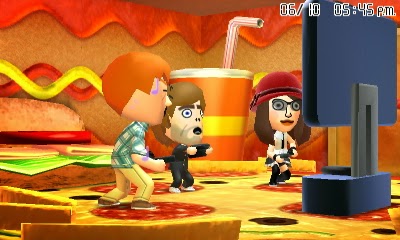
Once a day you can play a retro-style RPG game where your Miis, suitably transformed into pixelated sprites, wander through a simple dungeon and do battle with food items and objects from the game. As an RPG nut I had to make sure I gave this a mention, but while nostalgia inducing it is over-simplistic, as each character only has two types of attacks and the enemies similarly only have two. The various events in Tomodachi Life will keep you entertained for a while, but even they eventually run out and start repeating themselves with different Miis. However, as my images suggest, it is definitely fun seeing these events play out with different combinations of Miis, as the context completely changes based on which characters happen to be playing golf or having a pillow fight.

One of the smartest features of Tomodachi Life is the ability to take a screensnap of the top screen at any time by pressing X, and then using 3DS Image Share to post them to Facebook or Twitter. This means that you can capture that bizarre dream where your friend became a snail and send it to them along with Freudian commentary! There is no shortage of fun of taking pictures of your Miis in the Photo Studio, placing them in pairs or as a group using a variety of poses and backgrounds. This is where Tomodachi Life really shines, making it easy to share your island's silliness with friends and other enthusiastic proponents of the game, creating a community around who can provide the wackiest character combinations and scenarios.

What really keeps me coming back, and this surprises even me, is the potential for romantic involvement between my Miis. A heart symbol appears in a Mii's apartment when they want your advice about love, and I always get overly excited to see it. The scenes in the game involving love are the most interesting ones, and frankly, make me feel like I'm actually accomplishing something.

A Mii will develop romantic feelings for another Mii seemingly arbitrarily. A Mii interested in asking another Mii out will ask you where you think they should go on a date, and how they should act. Depending on what you choose and how they feel about one another, they'll either become sweethearts or walk away as friends. Sometimes a Mii will also offer to set up two other Miis, observing them incognito as the two go out on their date, and this too can be hit or miss, but it's pretty funny. As sweethearts you'll see the pairs constantly hanging out with each other, and if their love becomes strong enough, one of them will decide (with your blessing) to propose to the other one. You'll get to observe the proposal, helping out through a silly mini-game, and then see the wedding, in which many of your Miis appear as guests. Once they've settled down long enough, they'll ask if you think it's a good idea to have a baby. The babies are generally ugly as sin, but you can edit them. You then watch the baby grow up over a few days before becoming independent and either moving into an apartment on your island, or being set as a streetpass character who will show up on other people's islands. The baby book you see when a baby Mii grows up is surprisingly touching.

The one issue I had with having the Miis fall in love is that, as a control freak, I was trying to dictate who fell in love with whom, and though you can try to stifle a Mii's feelings for another Mii, there is no way for you to actively suggest which Mii who you think they ought to go for. This adds an element of surprise to the game, but left me feeling a bit defeated when I told a Mii over and over that her crush was a bad match, only to have her continually pine for him anyway.

I have a love-hate relationship with this game. I love it because I care about my Miis and all the shenanigans they (occasionally) get into, and I hate it because despite the fact that these Miis need you to hold their hand every second of the day, I still can't stop checking in to see if something eventful is happening in their lives. Though I often open my 3DS with a groan seeing that my Miis are asking to have their same basic needs met, every so often I'm rewarded with something new and exciting. Tomodachi Life is a game to be savoured, taking your time between check-ups to ensure that there's fresh material waiting for you and that you don't get bored too quickly by the regular requests of your Miis. If you're going to get this game, be aware that it's a bit of a slow burn, but if you enjoy the idea of bringing together people both real and imagined from all walks of life, watching them go about their lives and getting into cheerfully absurd situations, then this is a game for you.