Showing posts with label Games. Show all posts

Monday, 9 February 2015

Telltale crafts a truly authentic Game of Thrones experience

Game of Thrones The Lost Lords The Wall

For those of you anxiously pining for HBO’s Game of Thrones to return on April 13, it seems as if the long winter from George R. R. Martin’s fantasy universe is already upon us. Take solace in the Game of Thrones game by Telltale that not only captures the look and feel of the HBO universe, but also puts you in morally ambiguous situations that would make the novels’ procrastinating author proud.

Game of Thrones The Lost Lords Funeral
When you play the game of thrones, 
you win, or you die.

The game follows House Forrester, previously banner men to House Stark, who after the fall of Robb Stark and Lord Forrester during the infamous Red Wedding are thrust into one tragedy after another. As various members of House Forrester you navigate all manner of dubious alliances, sticky political intrigues, skullduggery and gory combat in an effort to win back your family’s strength and honour. Though like in the show and novels, it’s never a good idea to become too attached to your favourite characters.

If you’re not traditionally into video games you need not worry. Telltale specializes in narrative-driven games that focus on storytelling and the choices you make, which will then alter the direction the story takes as you progress. The game is also released episodically, with the first two of six episodes out now, so if you’re time-strapped you can play it in two to three hour chunks.

Game of Thrones The Lost Lords Kit Harington John Snow
Kit Harington adds his silky voice and likeness
to Telltale's Game of Thrones.

If that’s not enough, HBO series actors including Peter Dinklage, Natalie Dormer, Kit Harington, Lena Headey and Iwan Rheon have lent their voices and likenesses to the game, making this a truly immersive Game of Thrones experience. I highly recommend this one.

The game is available on Steam for PC and Mac, as well as PS3, PS4, Xbox 360 and Xbox One.

Friday, 29 August 2014

Miyamoto on Nintendo's Creative Future, Winning Back Core Gamers

The internet is buzzing right now about Nintendo veteran Shigeru Miyamoto's interview in October 2014's edition of Edge magazine in which the iconic game designer and producer states that he is about making games for gamers, rather than cave into investor pressure to court to casual gamers and create free-to-play versions of Nintendo's storied franchises for smartphones. In response to Edge's comment that Miyamoto's upcoming games for Wii U that make extensive use of the Wii U gamepad: Star Fox, Project Guard, and Project Giant Robot, are difficult to play, Miyamoto emphasizes that while using the Wii U gamepad alongside your main view on the television screen does take some getting used to, it represents a new challenge that hardcore gamers will find satisfying once mastered. This is a complete paradigm shift from Nintendo's previous attempt to snag non-gamers with easy to play games like Wii Sports, and Miyamoto's controversial statement regarding the attitude of casual gamers is particularly striking in suggesting that they are completely unengaged with the games they play: "Their attitude is 'OK, I am the customer. You are supposed to entertain me.' It's a kind of passive attitude they're taking, and to me it's kind of a pathetic thing. They do not know how interesting it is if you move one step further and try to challenge yourself." Bold words, but ones that suggest that Nintendo is taking a renewed interest in attending to the hardcore gaming community that many feel have been alienated since the inception of Nintendo Wii.

Which is not to say that Nintendo will be making proprietary Call Of Duty-like games to win back the hardcore gamer element. Miyamoto was unimpressed with the general showing at E3 2014, commenting that there was far too much "bloody shooter software" that demonstrated that the industry is trapped in a state of "creative immaturity" as developers continue to build upon previous successes rather than attempt something brand new. He states in the Edge interview that he hopes "Nintendo will always be a company that aggressively invests in something new - something born from each creator's individual characteristics." His solution to this desire for expression is Nintendo's Garage program, in which Nintendo developers break off into small teams to work on ideas, the most successful of which are then taken on as full-fledged projects. The three aforementioned Wii U projects, along with E3 2014's heavily featured Splatoon, the company's non-violent take on the competitive shooter, are the first games to be realized through this initiative. Miyamoto suggests it's all about staying true to Nintendo's roots: "With the increasing number of developers involved in one project, we need to spend longer simply communicating, so we can feel the same pleasure [as the old days]."

Concepts like Splatoon, a game reminiscent of Super Mario Sunshine in which the object is not to kill your opponents but use paint guns to coat more territory on the map than the other team, represent this revitalized spirit of ingenuity over at Nintendo. In taking the tried and tested FPS genre and turning it on its head, Nintendo is demonstrating that they recognize this important corner of gamer society, while being able to add their own unique spin on it. Splatoon was almost made as a Mario game, but Miyamoto states that "If it were Mario, we wouldn't be able to create any new [Intellectual Property]," which is refreshing to hear from a company that has played it particularly safe in its proprietary software decisions in the past decade. It's no secret that Nintendo has not been doing very well financially, but gambles such as this, along with tried and tested upcoming games like Super Smash Bros. and the as-yet unnamed open-world Zelda title for Wii U, might just help Nintendo reengage with its estranged core gamer audience and regain lost ground as a popular innovator in the games market.

You can read the full interview with Shigeru Miyamoto in Edge Magazine.

Thursday, 28 August 2014

No Objection to Professor Layton vs. Phoenix Wright Arriving Stateside

Professor Layton vs Phoenix Wright Cover

Fans of both the Professor Layton and Phoenix Wright franchises have been waiting a long time to see Professor Layton vs. Phoenix Wright: Ace Attorney hit the North American Market, and tomorrow their long wait is over. Combining the point-and-click adventure and puzzle solving of Professor Layton with the visual novel storytelling and courtroom drama of Phoenix Wright, this collaboration between Capcom and Level-5 marks the first time these two studios have ever worked together. The game's original story is written by Phoenix Wright series designer Shu Takumi, and makes use of the beautiful hand-drawn backdrops of the Professor Layton series, as well as the 3D graphics that were present in Phoenix Wright's latest 3DS outing, Dual Destinies. The game also includes anime cutscenes from the Bones animation studio.

The story begins in London, where Professor Layton and his assistant Luke are assisting Espella, a young woman being assaulted by mysterious forces, and encounter a magical book that transports them to a strange medieval city named Labyrinthia. Phoenix Wright and his assistant Maya Fey, in London on business, find the same book and are similarly transported. The four heroes have to combine their talents to solve the mysteries surrounding Labyrinthia, while also defending Espella in court as she is accused of witchcraft.

Professor Layton vs Phoenix Wright screen
It is a real treat to see Wright and Layton encroaching upon each other's territories, both being very intelligent (and somewhat arrogant) heroes in their own right. Players unfamiliar with the one or both of the franchises will get a crash course in lateral thinking as they are required to use their stylus to engage with townsfolk, find clues and solve all manner of puzzles (Professor Layton's forte), while also being tasked with rooting out contradictions in courtroom testimony, and presenting evidence at the right time to catch your witnesses off guard and expose their lies (the dominion of Phoenix Wright). Fans of one franchise or the other should find the gameplay stimulating, and those who are fans of both already are in for a real treat as we see Layton and Wright go tête-à-tête, and use their unique abilities to work out the nuances of Labyrinthia's mystery together.

Professor Layton vs. Phoenix Wright: Ace Attorney has been out in Europe since March 28, 2014, and has garnered a healthy Metascore of 79 on Metacritic.

Tuesday, 22 July 2014

Review of Cards Against Humanity

Thank you to my blogger pal Mike of The Blog of Thog for this guest post on Cards Against Humanity. I'll be off the blogosphere for a while, catch you all in a few weeks!

Cards Against Humanity
Cards Against Humanity is a horrible game. Anyone in their right mind should not play this game, not for a moment.

If you're not in your right mind, however, read on. It's awesome.

Cards Against Humanity is a card game for three or more players, with a really simple premise. You have two types of cards - black question cards, and white answer cards. Each person takes a turn to be the "Card Czar" and draws a black card. They ask the question on the card, for example "What's the new fad diet?" and the other players have to put forward one of their white cards as an answer to the question. And when everyone has put forward a white card, the Card Czar reads them out, and gives the funniest one the black card. Everyone who put forward a white card draws a new white card (people always have ten white cards) and the next person becomes the Card Czar.

But the game really depends on you and your friends having a, shall we say, questionable sense of humour. If we take the example question, "What's the new fad diet?", some of the questions that come back could include:

"Authentic mexican cuisine"
"Oompa-Loompas"
"Italians"

And I've kept extremely polite in the possible answers above, some of them really do go into being potentially offensive - but that all depends on the people playing it.

Cards Against Humanity is a beautifully simple game. I love came games and board games, but the complexity of them often frustrates me, even supposedly simple games can have so many stages or rules, or exceptions to rules, that it can take some work understanding how to play, and you really can just jump into Cards Against Humanity and within a couple of minutes you're suggesting that your best friend drinks to forget Sean Connery.

If you are of a legal drinking age, then it is fair to say that a drop or two of alcohol won't hurt the game, in fact it'll probably improve it somewhat, but I have played it sober and it is still brilliant fun.

Find out more about the game at www.cardsagainsthumanity.com - you can buy a set (there are different sets available for US, Canadian, and UK players) or even print it out for free. There are stacks of fan translations into other languages too, even Pirate!

So try Cards Against Humanity.

If you and your friends aren't easily offended, that is!

Mike, when not drinking to forget Sean Connery, blogs over at thoggy.blogspot.com and produces mediocre quality videos at youtube.com/ravenswingthog.

Tuesday, 8 July 2014

The Emotional Journey of Shovel Knight

WARNING: The following article contains spoilers for the story of Shovel Knight.

Shovel Knight Characters
Shovel Knight by Yacht Club Games is one of the best games I've played in ages. A loving homage to the 8-bit NES games of my childhood, it is both nostalgic and fresh, with challenging platforming and boss fights, lots of secrets, an intelligent loot system, and an original epic chiptune score by Jake Kaufman. All of these factors make for an amazing game, and tying it together is a well-told and surprisingly emotional narrative with memorable characters and bosses that really define the world you're playing in. This focus on emotional storytelling raises Shovel Knight above the status of the traditional platformer, in which story is generally less important than action, into the realm of art. The storytelling is achieved primarily through Shovel Knight's conversations with other characters, which are brief so as to not detract from the action, but manage to develop each of the characters' personalities and motivations, making Shovel Knight's quest feel much more personal than the stories from the games in which it draws inspiration. At the crux of the story is Shovel Knight's relationship with Shield Knight and the resulting rivalry with Black Knight. This is developed through Shovel Knight's repeated encounters with his dark counterpart, and Shovel Knight's dreams in which you really sense his deep feelings for Shield Knight, all of which works to make the conclusion of the game all the more satisfying. It's amazing how well the story is defined through such limited interaction, and the story resonated with me so much that it is these memories of the game, more than the action, that will continue to linger with me in the years to come.

Shovel Knight Shield Knight
Shovel Knight is not the mute, two-dimensional character that so many platformers have adopted in the past. He speaks fairly often, giving his actions within the game context, and is given a tragic backstory to augment his shovel-hacking ability. The titular character of the game starts out as a broken man, having lost his partner, Shield Knight, through a dark and powerful magic. He goes into retirement, but when evil confronts the land again, and the Tower of Fate where Shield Knight fell is unsealed, he comes out of retirement to kick some enemy tail. The introduction to the game gives you context for the action, not unlike the old games platformers it was based off of, such as Castlevania and Mega Man. Generally speaking, however, those older games dropped character development beyond the initial story, whereas Shovel Knight continues to develop as a character as the game progresses.

Shovel Knight Black Knight
Rather than just beating people up for the shallow reason that they are bad and he is good, we see through Shovel Knight's interactions that he lives by a code where he tries to avoid conflict when he feels it is unnecessary, often trying to talk his way out of a fight, but never backing down against those who prey on the defenceless. He is a paragon of justice, and his personality is defined to act as a perfect foil for The Order of No Quarter, knights with huge egos who have pledged allegiance for various reasons to the game's primary antagonist, The Enchantress.

Shovel Knight Treasure Knight
In true Mega Man style, each member of The Order of No Quarter has their own stage, with traps and enemies that are reflective of the boss' theme or powers. In Mega Man, these stages work to define the character of the stage's bosses whose motivations were rather shallow, but Shovel Knight takes this a step farther by defining these boss knights' character against Shovel Knight's through conversations between them prior to each fight. The Order of No Quarter are seen to be fighting for various personal reasons related to their own ambition rather than blindly following The Enchantress for the sake of 'evil.' For instance, King Knight gets raised from a lowly servant to become the King, and Treasure Knight is able to take advantage of the chaos sewn by the sorceress to secure all his ill-gotten gains.

Shovel Knight Treasure Knight
The boss conversations are short, and yet manage to turn what would otherwise be straightforward 'good versus evil' boss battles into a battle between righteousness and dishonour. The satisfaction of beating each boss amounts to more than simply being able to learn enemy attack patterns and time attacks; Shovel Knight's conviction is at stake. Rather than each boss feeling merely like just another roadblock towards the game's final encounter, every victory feels significant, as if you are removing a scourge upon the land independent of their service to the larger enemy.

Shovel Knight Black Knight End
A notable exception to the Order of No Quarter is Shovel Knight's rival, Black Knight. You fight with him several times, over which you learn that their feud goes back a ways. His motivations are initially unclear. You see him engaging with The Enchantress, and though he refuses to fight for her, he also continues to impede your path to The Tower of Fate. Eventually it becomes apparent that Black Knight is aware that The Enchantress is actually Shield Knight, who has been transformed by the dark magic. All of a sudden their feud makes sense, they're fighting over a woman. Black Knight has been trying to prevent Shield Knight from hurting, and possibly killing, Shield Knight. This is not mentioned explicitly, but by pacing out the encounters with Black Knight and dropping hints here and there, a portrait of their feud, much larger than what is actually presented in the game, is made apparent. Black Knight admits that he's not strong enough to take The Enchantress down, and this admission plus the knowledge we gain of his love for Shield Knight transform him immediately into a sympathetic character. What's amazing is how all of this character development is accomplished through very limited exposition.

Shovel Knight Dream Shield Knight Fall
Shovel Knight does not escape his battle against The Order of No Quarter unscathed. While he is strong, we see he is not infallible as he requires rest, and slumbers by the fire between stages. This gives the character a distinctly human quality, sets the game's quest within a more realistic timeline, and provides the backdrop for one of Yacht Club Games' most clever methods of character development: Shovel Knight's dreams. In these sequences, Shield Knight is falling from the sky, and after a few moments of fighting off a swarm of enemies, the prompt "catch her" appears on the screen, and in slow motion you must rush over as she falls. The outcome is the same whether or not miss you miss catching her (Shovel Knight wakes up), but does it ever feel horrible if you miss. These sequences are brilliant, as they manage to convey without words Shovel Knight's pain and regret over losing Shield Knight, and in waking up upon catching her you can genuinely feel the loss that one feels when waking up from a pleasant dream.

Shovel Knight Catch
These sequences also turn out to be a form of foreshadowing, as after you defeat The Enchantress and Shield Knight is freed from the power of the dark magic, you must catch her one last time, but this time for real. The game's creators do such a great job of building up emotional expectation through the interrupted dream sequences that the realization of those dreams is made all the more potent. Having Shield Knight then fight alongside Shovel Knight in the final battle is a sweet touch that shows how well they work as a team, and why they were considered a force to be reckoned with. When Shovel Knight is knocked out and Shield Knight stays behind to offer protection while Black Knight carries Shovel Knight away, the worry that she is gone for good after having finally found her again is palpable, and had me clinging to my 3DS during the credits to wait for the final payoff.

Shovel Knight End
Yacht Club games has truly created something special in Shovel Knight. The story elements of the game are quick and never detract from the action, but for all their brevity manage to define a much larger world which is easy to get lost in. The protagonist's personality and motivation become well-established, and his enemies no less so, leading to rewarding, weighty encounters. Most importantly, the player is allowed to take a glimpse into the heart of the character he controls, something which is all too rare in games. 'Rescuing the Princess' is such a common trope in video games, but so rarely do we really get a sense that the hero actually cares for her, or even feels remorse for having lost her in the first place. Shovel Knight takes what we loved about the NES era and combines it with a unique storytelling aesthetic that allows the player to truly resonate with its hero, proving that you can have a fast-paced and action-packed platforming spree without sacrificing story to do so. I dig it.

Tuesday, 1 July 2014

Video Game Danger in 'When You Broke My Heart'

When You Broke My Heart
Currently up for this week's Awardeo Video of the Week, When You Broke My Heart is a colourful short film by a group of French Animators about a King who loses his Queen when he ignores her for his video games, and then, after being confronted by a physical manifestation of his sadness, embarks upon a quest to win her back. It's a love letter to Japanese kawaii and to video games, with an unexpected ending that reminds us that it is possible to have too much of a good thing:

I was immediately struck by how the characters in the film are quite fluid, and I don't just mean the liquid movements of the amorphous avatar of sadness conjured by the King. Characters' limbs and faces contort and stretch in such amusing ways, imbuing the film with loads of energy, with each grimace and double-take pulled straight out of Japanese anime. The video game references are numerous, from Space Invaders wallpaper and amusing arcade machines in the throne room (PacNyan anyone?), to the authentic-looking late 80s Gameboy, or 'Geekboy' as it is called, that helps the King on his quest. The authentic gaming sounds are nostalgia inducing, and are a fitting backdrop for the King's obsession; Even though the King decides to give up his Geekboy to win back his Queen, he still lives as if he were in a video game, jumping from platform to platform before confronting the final boss.

As someone who plays a lot of video games and also has a special lady in his life, I definitely take the message of this film to heart. I'm not sure whether it was intended or not, but to me this film clearly demonstrates the danger not only of ignoring someone special in your life, but also (in its twisted ending) how easily you can take something which is meant to be a fun, occasional distraction and have it completely dominate your life. A big kudos to the film's directors: Charles Lemor, Lisa Fenoll, Anaïs Gresser, Anna Masquelier and Laura Fleischmann.

You can find lots of behind the scenes concepts and designs on the film's website.

Wednesday, 25 June 2014

My Tomodachi Love-Hate Relationship

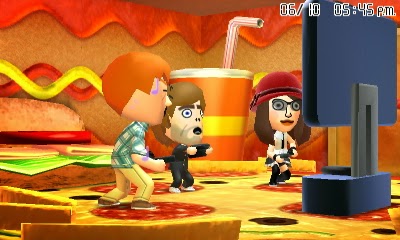
Every morning when I wake up, one of the first things I absolutely have to do is ask my good friend if he has worked up the courage to ask his sweetheart to marry him, check with all the tenants of my apartment building to see if they need me to fetch them something from the supermarket, and whether or not Scarlett Johansson and Jerry Seinfeld have finally had their baby. If this sounds exhausting, pedantic, and bizarre, it is, but it's also strangely rewarding. I'm glad it's not reality though, rather these are my duties in the wonderfully silly world of Tomodachi Life on Nintendo 3DS. Tomodachi Life is Nintendo's answer to The Sims. It's a game where you design or import Miis to live on an island and watch them live and interact with one another. Your Miis form friendships, get into fights, work in the local shops, fall in love, and eventually even get married and have children. The scenarios they play out are really funny, and it's fun watching which Mii is hanging out with which, and who is falling in love with whom, and what sort of bizarre dreams they've been having. The problem is, the game gets incredibly repetitive. Miis constantly have mundane problems, whether they're sick, or want a new wardrobe, or simply want to show you a silly face, and I can only feed Miis so many times before I feel like hurling my 3DS out the window. Yet, I keep coming back. My friend still hasn't asked his sweetheart to marry him, and there are still babies on the way. I've been trying to maneuver Samus Aran's affections towards a friend of mine, and maybe today is the day. Tomodachi Life is basically a slightly more complex version of a Tamagotchi pet, and is just as addictive.

Part of the game's charm is watching your friends and various celebrities and characters interact with one another. The 3DS makes it very easy to import user created Miis through the use of QR codes, and there's no shortage of Mii databases on the web. As a result, Reggie from Nintendo and Hank Hill are residents of my island, and I'm happy to say that Reggie is very happily married to a good real-life friend of mine, though Hank Hill remains an obstinate bachelor. Daria (from the show of the same name) tried to set Hank up with Samus, but they didn't hit it off. She's married to Tyrion from Game of Thrones. Walter White married another good friend of mine, and I'm thankful that so far he hasn't given her the Skylar treatment. Just another day on Neo Jeo island.

The Miis can all talk by using text-to-speech, and it's pretty fun hearing your friends say the silly catchphrases you come up with for them. You can dress your Miis and change their room style, which has limited appeal, although I do enjoy seeing Reggie in his leatherdaddy outfit with a horse mask over his head. While the problems of the Miis are obnoxious, solving them increases their happiness which allows them to level up, and with every level you can offer your Mii a gift, such as a baseball bat or a 3DS, which you can see them using in their apartments or the various locales of your island, often alongside a friend who has the same item. This gives you the illusion that the Miis are independent, but at the end of the day if they want something, including becoming friends or sweethearts with another Mii, they're going to approach you first. It seems a bit much to me that I can't simply load a Mii's fridge full of food to keep them fed, or give them license to make their own decisions. Helping a Mii get a sneeze out is simply a little too much micromanagement for my tastes.

Another potential gift choice you can also offer your Miis when they level up are one of eight types of songs, which allow them to perform in the island's concert hall solo or with other Miis who know the same type of song. Lyrics of the song are editable, meaning you can create your own song which you can then potentially record with your phone and post to Youtube, if you were so inclined. All these things are fun at first, but get boring pretty fast. The Miis offer to play games with you to keep your attention, but they're pretty lame ones such as "guess whose silhouette this is" and matching tiles. You get various items you can give your Miis, such as music boxes and swings, and while these raise their happiness and give you a variety of ways to interact with the Miis, the resulting scenes too become very repetitive. If this were all Tomodachi Life had to offer, I'd have stopped checking my island long ago. However, there are events that happen on your island to look forward to, even if they're somewhat few and far between.

Events happen at different points of the day. Once in the morning and in the evening the game produces news reports broadcasted by one of your Miis, showcasing still images of your islanders engaging in funny situations, such as enjoying candy that looks like one of your Miis, or helping a beached whale out to sea that turns out to be a whale toy. Miis of the same gender often get together in the local cafe to have a gossip session, chatting about their hopes, ambitions, and the other islanders. The Miis' dreams, which you can check in on while they're sleeping, are definitely highlights, turning them into marionettes, or placing them awkwardly at a table with duchesses speaking around them, or transforming into superheroes shoujo-anime style. Miis have bbqs, hold magic shows, and have rap battles.

Once a day you can play a retro-style RPG game where your Miis, suitably transformed into pixelated sprites, wander through a simple dungeon and do battle with food items and objects from the game. As an RPG nut I had to make sure I gave this a mention, but while nostalgia inducing it is over-simplistic, as each character only has two types of attacks and the enemies similarly only have two. The various events in Tomodachi Life will keep you entertained for a while, but even they eventually run out and start repeating themselves with different Miis. However, as my images suggest, it is definitely fun seeing these events play out with different combinations of Miis, as the context completely changes based on which characters happen to be playing golf or having a pillow fight.

One of the smartest features of Tomodachi Life is the ability to take a screensnap of the top screen at any time by pressing X, and then using 3DS Image Share to post them to Facebook or Twitter. This means that you can capture that bizarre dream where your friend became a snail and send it to them along with Freudian commentary! There is no shortage of fun of taking pictures of your Miis in the Photo Studio, placing them in pairs or as a group using a variety of poses and backgrounds. This is where Tomodachi Life really shines, making it easy to share your island's silliness with friends and other enthusiastic proponents of the game, creating a community around who can provide the wackiest character combinations and scenarios.

What really keeps me coming back, and this surprises even me, is the potential for romantic involvement between my Miis. A heart symbol appears in a Mii's apartment when they want your advice about love, and I always get overly excited to see it. The scenes in the game involving love are the most interesting ones, and frankly, make me feel like I'm actually accomplishing something.

A Mii will develop romantic feelings for another Mii seemingly arbitrarily. A Mii interested in asking another Mii out will ask you where you think they should go on a date, and how they should act. Depending on what you choose and how they feel about one another, they'll either become sweethearts or walk away as friends. Sometimes a Mii will also offer to set up two other Miis, observing them incognito as the two go out on their date, and this too can be hit or miss, but it's pretty funny. As sweethearts you'll see the pairs constantly hanging out with each other, and if their love becomes strong enough, one of them will decide (with your blessing) to propose to the other one. You'll get to observe the proposal, helping out through a silly mini-game, and then see the wedding, in which many of your Miis appear as guests. Once they've settled down long enough, they'll ask if you think it's a good idea to have a baby. The babies are generally ugly as sin, but you can edit them. You then watch the baby grow up over a few days before becoming independent and either moving into an apartment on your island, or being set as a streetpass character who will show up on other people's islands. The baby book you see when a baby Mii grows up is surprisingly touching.

The one issue I had with having the Miis fall in love is that, as a control freak, I was trying to dictate who fell in love with whom, and though you can try to stifle a Mii's feelings for another Mii, there is no way for you to actively suggest which Mii who you think they ought to go for. This adds an element of surprise to the game, but left me feeling a bit defeated when I told a Mii over and over that her crush was a bad match, only to have her continually pine for him anyway.

I have a love-hate relationship with this game. I love it because I care about my Miis and all the shenanigans they (occasionally) get into, and I hate it because despite the fact that these Miis need you to hold their hand every second of the day, I still can't stop checking in to see if something eventful is happening in their lives. Though I often open my 3DS with a groan seeing that my Miis are asking to have their same basic needs met, every so often I'm rewarded with something new and exciting. Tomodachi Life is a game to be savoured, taking your time between check-ups to ensure that there's fresh material waiting for you and that you don't get bored too quickly by the regular requests of your Miis. If you're going to get this game, be aware that it's a bit of a slow burn, but if you enjoy the idea of bringing together people both real and imagined from all walks of life, watching them go about their lives and getting into cheerfully absurd situations, then this is a game for you.

Thursday, 12 June 2014

Cuphead and the Golden Age of Cartoons

Fleischer Bimbo and Cuphead

Perhaps the most impressive looking game shown at this year's E3, Cuphead, by Studio MDHR, is a run and gun sidescroller drawn in the style of cartoons from the 30s. The art style immediately evokes the animation of Max Fleischer, a king of the golden age of cartoons. Among his creations are Bimbo (pictured to the right of Cuphead), his bombshell girlfriend Betty Boop, and Popeye (who was originally a comic strip character whom Fleischer bought the rights for and launched to international stardom, briefly even eclipsing the popularity of Mickey Mouse). The visual style of Cuphead is an animation fan's fantasy, and it's looking to be a genuinely fun co-op gaming experience. Studio MDHR's plans are ambitious to say the least:

"With Cuphead, we aim to evolve the genre by adding new features such as: super arts, infinite lives, a playable world map and hidden secrets. In addition to that, we will have refined controls, additional boss patterns on harder modes and balanced weapons to equip (that you don’t lose!). We plan to release 10-15 bosses per episode and end up with over 30 bosses. If all goes as planned, we will defeat the current “Guinness World Record for Most Boss Battles in a Run and Gun Game”[25 total])."

Cuphead Silver Squid Attack
As far as I'm concerned, the game already holds a world record for the number of ways it enters my heart. Not only is the cartoony nature of the game fantastic, but the devs are drawing their gameplay influences from pinnacles in the run and gun genre including Gunstar Heroes, Contra III, and Mega Man X. The animation in this game is looking super smooth, and the main characters, Cuphead and Mugman, zip through the stage with the omnipresent grin of the black and white cartoon character, and emote handsomely as they take damage or shoot pellets with a snap of their fingers. The enemies showcased are similarly impressive, sporting smoothly animated attacks and sinister grins. Studio MDHR promises variety in the types of boss fights you encounter, from a cranky sea captain to a rampaging flower, and variety in the strategies required to beat them. So far the footage shown of the game has been limited, but perhaps that's for the best as if I saw more at this point I'd want a copy right now in my grubby little hands. The game's release has been pushed back to 2015, and I'll be waiting impatiently for its arrival.

You can visit Cuphead on his official website, or Studio MDHR on Facebook and Twitter.


Monday, 9 June 2014

What We Hope To See From Nintendo's E3 Livestream

Nintendo Treehouse Live at E3 2014

It's E3 time! Tomorrow Nintendo is holding their live stream event starting at 9AM PST with information on games we've been waiting desperately for and the promise of the announcement of new games to come. The so far unseen Zelda for WiiU is going to be showcased, and a large focus is going to be on Smash Bros. for WiiU and 3DS. It's no secret that Nintendo has been having fiscal problems, part of which they plan to solve by creating a line of figurines that you can link to your games a la Skylander or Disney Infinity, but Nintendo's success has always been in its ability to delight its fans not with gimmicks but with games that are truly fun, epic in scope, and full of character. I may not work for Nintendo, but I am pretty sure we I what Nintendo needs to work on to get back on track:

A New Metroid Game: Whether first person or side-scrolling, Nintendo has been sorely lacking recently in titles starring everyone's famous bounty hunter Samus Aran. Set in the backdrop of space, hunting space pirates and solving the mystery of the jellyfish-like metroids, her adventures are truly worthy of a new installation. Retro Studios proved that Metroid could be pulled off well in first-person, but taking a cue from all the Metroidvania indie projects out there I'd even enjoy a retro side-scrolling Samus adventure. Like Zelda, Metroid is one of Nintendo's darker franchises, and it would be great to see Nintendo flex its creative muscles to bring this fantastic series into a new generation.

A New Starfox Game: If you believe this leaked Document listing Nintendo's titles being showcased at E3, this may soon be a reality! Fox, Falco, Peppy and Slippy have been languishing on Corneria, and it's about time for their return. An HD version of Star Fox on WiiU would probably be one of the most beautiful titles the system would produce, and the 3DS would loan itself well to Star Fox, giving players the option to use traditional or gyro controls and allowing for three-dimensional combat with friends over Wi-Fi. It's time to get mad at Slippy again!

A Brand New Franchise: Pikmin came out in 2004 to great acclaim, and while perhaps Nintendo would be reluctant to put their faith in a new product considering their financial straits, some new blood might just be what Nintendo needs to reinvigorate their image. Nintendo is nothing if not inventive, and probably has all kinds of ideas floating around just waiting to be developed. Be brave, Nintendo!

More Co-Op Games For 3DS: My poor 3DS is just dying for new games that I can play with my friends. Mario Kart 7 has been usurped by Mario Kart 8, and though Smash Bros. is coming out soon, there simply aren't enough co-op options for the delightful handheld. Streetpass and Pokemon are all well and fine, but the handheld has so much potential for real-time fierce multiplayer matches or engaging co-op with each player having their own screen. Consider perhaps a Mario game that has four player co-op like its WiiU's Super Mario 3D world over wi-fi, or (I say again) Star Fox space battles. Help me get my game face on, Nintendo!

A Console With Less Gimmicks: We're not likely to see it this E3, but how amazing would it be to have Nintendo go back to the basics with their consoles, pumping in a little more power and having standard controllers as default (I still think the N64 controller was the best). Perhaps then it would be easier for Nintendo to re-attract the third party games that they desperately need to provide a much-needed source of income. I admire Nintendo's inventiveness and do feel that it has a place, but this really ought to be secondary to creating great software. Also, playing Mario Kart 8 with a wii-mote and nunchuck just doesn't feel natural.

Localize Mother 3: This is reaching a bit. Fans of Earthbound have been dying for Nintendo and HAL Labroatory to release this Japanese-only cult-classic in the North American market. Written by Shigesato Itoi and directed by Nobuyuki Inoue, Mother 3 is the sequel to the wildly popular RPG Earthbound, a game with deceptively light themes that is also emotionally resonant and philosophical. Fans who have played the sequel's online fan translations say that it is even more profound than its predecessor, so shut up and take my money, Nintendo and HAL!

More Donkey Konga: Who doesn't love bongos? Louie Louie by the Kingsmen? I'm shocked that Nintendo hasn't released a bongo peripheral for WiiU yet considering how vastly popular this franchise was. Bang and bong along to you favourite B-list songs from the 90s and general obscurity with Donkey and Diddy Kong. Step 1: Bongos. Step 2: ???. Step 3: Profit!

Agree? Disagree? Anything else you think Nintendo needs to work on? Comment below!

Thursday, 5 June 2014

Betrayal at House on the Hill Review

Betrayal at House on the Hill Box

Today's blog post can be found on Mike Raven's The Blog of Thog. Mike's a tabletop enthusiast and humorist, and I leapt at the chance to write a piece for his blog while he's on vacation.

I picked up Betrayal at House on the Hill after seeing Wil Wheaton and company play it on an episode of Tabletop by Geek & Sundry. I've played it a few times now, and really enjoy it - though it's not without it's flaws. Check out my review:


Watch Tabletop to see it in action:


Saturday, 31 May 2014

Game Preview: Mighty No. 9

Mighty no. 9 Beck Drawing Board
Classic Mega Man fans have been clamboring to get a look at the progress of the Kickstarter game project Mighty No. 9, and yesterday our prayers were answered as the team at Comcept put up footage from their latest beta. Spearheaded by Keiji Inafune, a long time veteran of the wildly successful Mega Man franchise, the Kickstarter campaign sought a mere $900,000 to get off the ground. 67,226 backers and $3,845,170 later, the project now will contain bonus stages and bosses, various extra modes including an online battle race mode, and will be released on PC, Mac, Linux, WiiU, PS3, PS4, Xbone, Vita, and 3DS. The game is described on the Kickstarter page as follows:

"You play as Beck, the 9th in a line of powerful robots, and the only one not infected by a mysterious computer virus that has caused mechanized creatures the world over to go berserk. Run, jump, blast, and transform your way through six stages (more than six, since the stretch goals for the project were demolished) you can tackle in any order you choose, using weapons and abilities stolen from your enemies to take down your fellow Mighty Number robots and confront the final evil that threatens the planet!"

Mighty no. 9 Call Contest Winner

Blast? Tackle? Confront? Yes please! Talk about nostalgia, Mega Man sidescrollers always had a certain energy and challenge to them that it seems like the team at Comcept is implementing well so far. The graphics are sleek and new but without sacrificing the timeless look of Mega Man's 32-bit Mega Man X days. The boss concepts look suitably deadly and fun, with a plethora of different attacks to keep you on your toes. Meanwhile the community of Kickstarter backers has been lively, with Q + A and fanart being being displayed by the team in the Kickstarter's updates on a regular basis. Clearly people are excited! The team even held a community vote to choose the look of Beck's companion Call in the game (get it? Beck and call?), with the winner displayed here. I can't wait to see what sorts of abilities Beck will be able to get. Apparently you not only get powers from bosses, but from enemies as well:

Mighty no. 9 boss no. 3
"It’s not only killing bosses that gets Beck new powers. Taking out other enemies with a certain weapon, or hitting them in their weak spot, can expose one of three types of “xel” (pronounced “cell”) energy Beck can sap (if he’s quick enough), store, and unleash later via his own Mighty Skills! Give yourself a double-jump and speed boost for a limited time, unleash a concentrated flurry of powerful punches directly ahead, or set off a blast that hurts everything on the screen! Whatever final form it takes, this system will add depth and strategy to the action, as you choose how to approach and defeat even normal bad guys to best fuel your special powers."

Considering this video is making my thumbs tingle and we've only had the most basic look at Beck's attacks and enemies, I think it's fair to say that I'm pretty stoked to play this game on my 3DS. Mega Man on Nintendo, just like the good old days. Only another year to wait! I just hope they implement the fateful scrolling boss corridors.

Follow Mighty No. 9 through their Kickstarter page or through Facebook.

Thursday, 29 May 2014

Moving Out To The Country: Transistor Review

Transistor and Red


"When you speak I hear silence
Every word a defiance
I can hear, oh, I can hear,

Think I’ll go where it suits me
Moving out to the country
With everyone, oh, everyone,

Before we all become one"

These are the meaningful words of "We All Become," the title song of Supergiant Games' newest release Transistor, an isometric action-RPG set in the sprawling city of Cloudbank. As the spiritual successor to Supergiant Games' previous hit Bastion, Transistor had a lot of living-up to do, and I was certainly not disappointed. Supergiant's wonderfully gravely narrator Logan Cunningham from Bastion returns, the art direction and music are immaculate, and the combat system is engaging, encouraging you to take down enemies as efficiently as possible using a vast array of attack configurations. While I did feel like they stayed a little too close to Bastion's overall mood and that the game was a bit too short, I had a real blast playing through it, kicking butt and learning about the mysterious world I was thrown in to.

Transistor World of Cloudbank
The stunning world of Cloudbank
The scenario Supergiant has spun is larger than life and rife with secrecy. Red, the game's protagonist diva who lost her voice, carries around the Transistor, a tool of mysterious origin that is voiced by Cunningham after it is used in a murder. People are disappearing, and all you know is that a secret society known as the Camerata are to blame. Like in Bastion, the story is developed primarily through the narration of Cunningham, who makes practical and cheeky comments as you progress through the levels, adding life to a world that is otherwise depopulated - except for the Process. These buggers are your main force of opposition that are ripping the world apart, and you need to use the Transistor to stop them. The story is quite cryptic at times, and you need to piece together what is happening through the commentary from the Transistor, news reports, and various files you unlock. I rather like this type of storytelling as it assumes you have the smarts to piece things together.

The art style of the game, like Bastion's, is colourful and memorable. Cloudbank feels like a cross between a jazzy noir metropolis from the 50s and a futuristic prismatic cyberpunk wonderland. Influences are drawn from many sources including Art Nouveau and Art Deco motifs, with a touch of Gustav Klimt in the gold-trimmed patterning of Red's clothes and a dash of Alphonse Mucha in the posters of Red strewn around the sprawling city. The Process are sleek enemies that look like the cousins of EVA from Wall-E or a Portal turret, and just as deadly (remember when EVA blew all that stuff up in the junkyard?). Visually the game is an absolute treat, and I couldn't even play it on the highest resolution (old rigs, take note). The music, composed by Darren Korb with songs sung by Ashley Barret, is unique and memorable, and adds flavour and clarity to the story (you can read my separate review of Transistor's music here).

Transistor Function Screen
The many functions you can mix and match
to create devastating attack moves
The attack system is an art of its own. The amount of options you have to create attacks is staggering. There are sixteen base attack functions that you unlock as you level up throughout the game, and each function has an active, support, and passive mode. Active mode sets that function as one of your four primary attacks, Support mode lets you attach that function to any primary attack you have equipped adding secondary effects, and Passive mode gives Red passive abilities. The secondary abilities can drastically change the functionality of the primary attack, giving you quite the arsenal at your disposal with all the possible combinations. You are limited in the amount of functions you can equip at a time by the amount of memory you have, which also gets upgraded as you level up. Combinations can be absolutely devastating, particularly late game. Functions also work in conjunction with your health; when your health drops to zero, you lose the ability to use one of your equipped primary functions until you visit two new save stations. Your health goes back up after you lose a function, but if you lose all four of your primary functions then you die. The function system is smart; I was constantly experimenting with new combinations to see which attacks would work better against certain enemies, or simply how much crazy damage I could do. The game really lets you tailor your attacks to your own preferences, and rewards experimentation as you unlock files with backstory on Cloudbanks' citizens by equipping your functions in different slots. You will get hurt and lose functions, which feels almost as painful as dying as each function is useful and found I was always using a combination of all four in battle, so I felt powerful when getting through battles unscathed. While Red can attack in real time, more often you will be taking advantage of the games's Turn() system, which allows you to freeze time to queue up attacks to unleash in quick succession.

Transistor Battle Screen Turn()
Queue up your actions by freezing time using Turn()
and unleash them all in quick succession!
When Turn() is activated the battlefield turns into a dotted grid on a black plane. A blue bar at the top of the screen shows you how much potential movement / attack credit you have. You use up credit by walking as well as attacking. The amount of credit you lose per attack depends on the strength of that attack, and the amount of damage you will do to each enemy is displayed as you stack up each attack. Any move you make before you finalize your decision can be undone, therefore you have the delicious freedom to try out any number of combinations of attacks to see which is the most effective before you unleash the fury. Watching Red then execute those moves, ripping enemies to pieces with Matrix-like speed, is oh so satisfying. Once you use Turn() you only have to wait a short period before you can use it again, but enemies can be particularly ruthless during that time, particularly in late game. Sometimes the battles felt a bit easy with effective use of Turn(), but for those who want more of a challenge, the game has a "Limiter" system which, like the god system in Bastion, allows you to beef up certain aspects of your enemies creating tougher fights and higher experience gain. This ensures that gamers of all stripes are able to enjoy the game, whether they prefer casual encounters or hardcore slugfests.

Transistor Sandbox
Go to the Sandbox to relax -
or practice demolishing Process

Like Bastion, there are challenges you can perform to put your skills to the test (and gain more experience), which you access through the Sandbox, a beach bum's paradise you can visit from time to time (complete with beach ball). Tests challenge you to use Turn() to kill all enemies in one turn using prescribed functions, survive for a certain amount of time, kill all enemy waves, or kill all enemies in a set amount of time. These were initially fun, but the rewards were meagre amounts of experience and as the tests got frustratingly more difficult I found that I simply wanted to leap back in to the main story rather than rinse, wash, and repeat these tests every time I (shamefully) lost.

There are definitely a few things I hope to see changed with Supergiant's next outing. While Transistor does feel different than Bastion artistically, I can't help but draw a certain parallel that I wish Transistor had been able to avoid to feel truly unique: both games take place in worlds that are essentially devoid of other characters to interact with. Cunningham does an excellent job with his narration, bringing the world to life, but it would have been nice to see Supergiant tackle a world that is a little more lively with other characters to meet and flesh out the story. With Bastion this tack felt truly original, but in Transistor it feels a bit repetitive. Transistor makes an effort by adding files you unlock with character backstories, but it falls a bit flat without the possibility of actual interaction. While Transistor does have some fun secrets to find, the game feels a bit linear as those secrets are never far off the beaten track. The world is beautiful, though, and the combat is amazing, which is why it's a shame that the game clocks in at less than seven hours for the first playthrough. A New Game+ mode unlocks when you complete the game which allows you to continue levelling and unlocking duplicate functions for double usage, but what I crave is more time with those unique moments when a game is completely new and fresh and you're revelling in its awesomeitude.

Small quibbles aside, Transistor is still one of the most memorable games I've played in the past long while. It's one of those rare works where you feel like you're playing with a piece of art rather than playing a game. The world and its story are authentically crafted, the music is amazing, and the combat makes you feel like a valkyrie of pain on the battlefield. I definitely recommend this one to all fans of action and tactical rpgs, and generally anyone who likes a story that requires a bit of thought. Kudos Supergiant!

Transistor is available on Steam for PC and on PS4.

Friday, 23 May 2014

We All Become: The Music of Transistor

Red and the transistor album cover

In 2011, Supergiant Games, a tiny game developer in San Jose, released Bastion, a game for PC which garnered critical acclaim and won over 100 awards. This was in no small part due to the excellent audio direction, including the gravely narration of Logan Cunningham, the incredible score of Darren Korb, and the incomparable vocals of Ashley Barrett. This dynamic trio returns in Supergiant's recently released PC game Transistor, a sci-fi isometric RPG set in the fictional city of Cloudbank. Having played through just part of the game I can already tell that it's something special, but while I am still working through it I'd like to speak to its fantastic soundtrack by Korb with songs sung by Barrett, available to listen to on both Bandcamp and Youtube.

A disclaimer: the game's developers suggest not listening to the soundtrack till after finishing the game, as some of the games songs sung by Barrett are intricately linked to the plot. That being said, as Bastion's soundtrack is one of my favourite video game soundtracks of all time, I couldn't resist listening to Transistor's soundtrack all the way through prior to finishing the game. The music perfectly blends the art nouveau, jazzy visual sensibilities of the game with the science-fiction theme through the combination of jazzy rhythms with traditional piano and guitar with electronic sounds from synth and electric guitar. The effect is truly one of a kind, and the lounge-style numbers of Ashley Barrett, the voice of the diva hero of the game named Red, tie the whole album together into a unique and satisfying package.

The tracks are varied and reflect the mood of the situations Red finds herself in well. The album begins with "Old Friends," a steady number that introduces you to the game with a rhythmic drumbeat and moody electric guitar riffs that build up slowly as cymbals join the fray, and you're transported to the mysterious world of Cloudbank. "Vanishing Point" and "Traces" both build up the tension related to the mysterious circumstances of the game and the growing unease Red faces as she begins to learn more about what is happening in the city. Tracks such as "Forecast" and "Apex Beat" pick up the tempo and throws Red into the thick of battle with a quickened drumbeat likened to a racing heart, piano undertones that suggest a hint of danger, and quickened guitar rifts that move as fast as Red can after she freezes time to attack using her Turn() ability. "Water Wall," one of my favourite tracks, sounds as if it could be played in a seedy hotel, and has the cadence of a slightly demented waltz number. Tracks such as "Gold Leaf" and "Dormant," build up the tension to the breaking point, utilizing threatening bass rhythms and sinister violin notes. The soundtrack definitely offers levity at points, however, such as in the tracks "Coasting," which sounds as if you might hear it at a beach resort, and "Sandbox" which contains island ukulele and guitar sounds and is where Red goes to relax in the game. The music does a great job of driving the story, but the real star of this soundtrack, however, is Ashley Barrett. In a game where the hero does not have a voice, Barrett's songs do a great job of building character for Red while also defining the message of the game.

As soon as I heard her song "We All Become" in the reveal trailer I was hooked, and I found myself humming it for days. A song of defiance, the background track has the energy of a quick melee in the streets, while Barrett's vocals are full of energy and sway, and her voice has the range in this track to convince you of both the danger and the solution. "The Spine" is a song fully reminiscent of the best lounge singers of the 50s, a song full of pain about the twisted nature of the plot Red has become aware of in the game. "In Circles" is a dark lounge number about Red's lack of pity for those who have attempted to manipulate her likening her enemy to a fly on the wall, now circling down the drain, which truly made me feel the unwavering conviction of her character. The rest I leave up to you, dear reader, to decide if you want to listen to before you finish the game or not.

Korb and Barrett together define a masterclass of music, a delightful duo. I look forward to seeing more of their collaborations in the future, whether with Supergiant or without. My review of Transistor should be coming soon, meanwhile here is Darren Korb and Ashley Barrett performing the end theme of Bastion, and "We All Become" from Transistor at PAX Prime 2013:

Wednesday, 21 May 2014

"The Banner Saga" Review: The Beauty of Loss


"The Gods are dead.

In their wake, man and giant
survived through a tenuous
alliance, driving black
destroyers called dredge deep
into the northern wastes.

Now is an era of growth
and trade. Life goes on.

Only one thing has stopped.
The sun."

So begins the epic tale of The Banner Saga, the first of a planned trilogy by Stoic for PC. A turn-based strategy game steeped in Nordic legend, this is a world where the sun has stopped, the dredge have started pouring in out of the North, the world is coming to an end - and you have a caravan to feed. It's an intricately crafted world, with characters and landscapes drawn impeccably to the style of Disney Artist Eyvind Earle, and is made all the more beautiful by the fact that it's crumbling down around you. Hard choices face you at every turn, and your decisions often mean that some of your party will live while others die. The world draws you in deeply for the roughly 10 hours it takes to complete, and truly makes you feel the weight of responsibility and loss.

Banner Saga Council
A council between varl and human
The art style of the game is no short of magical. The story takes place in a fictional realm steeped in snow where men and giants, known as varl, coexist. The art style is reminiscent of the older Disney movies like Sleeping Beauty, giving the game a magical feel that modern CGI is unable to achieve. Perhaps the most amazing aspect of this art style is that it is not only used for the character portraits and still images that help tell the story, but for the combat as well. This ensures that the illusion crafted by the game artists is never interrupted through the transition between the storytelling and the battlefield. The script of the game is advanced through some audio narration, but most of the story is told visually and with text, utilizing beautiful stills. The animation of your banner unfurling behind your caravan, a canvas used to stitch the story of your journey from which the game draws its name, is inspiring, and a constant reminder of the hardships you face as you watch your supplies dwindle on the march. Your party members are memorable and unique characters who engage with each other, further livening the already lush world created by the writers and artists of the game and driving the narrative forward. The introduction of the game has one full animated cutscene, and if I have one unfortunate thing to say about the art of the game its that there weren't more. The score, composed by Austin Wintory, is suitably epic, full of doleful winds and strings and enchanting vocals, and can be streamed or purchased here.

Banner Saga Battle
The battle system is engaging and requires you to think
your tactics through carefully before acting
The battle system in the game is reminiscent of Fire Emblem or Final Fantasy: Tactics in that units move and attack on a grid, but with enough original mechanics that it stands out from both. At the beginning of the battle you choose which order your party members will perform their actions. A progress bar at the bottom left of the screen dictates in which order your party and the enemy can act, with one player and one enemy taking alternate turns. Since you know exactly in what order you and your enemies will move, you can plan your battle strategy around enemies' potential movement and which party members you want in the fray, such as your tanks, and which party members you want to hold back, such as your archers and healers. All units have both a strength and an armour stat, and when they attack can choose to do strength damage, armour damage, or in the case of some special attacks, both. Strength is not only a unit's health, but the amount of attack power that unit has, so the lower a unit's health the lower their damage. You can not perform maximum strength damage to a unit, however, until you whittle down their armour first. This leads to interesting decisions regarding which units you choose to attack with in which order, as some units are better at destroying armour but weak at taking down strength and others vice-versa. All units also have a Will stat, which when spent lets them move farther than their normal movement or add extra power to their attacks. Will can be replenished by resting a turn, or through the horn at the top of the screen which builds up Will points to grant to units for every kill. Each type of unit also has a unique special attack using Will that further influences your decisions as to which units to move in which order, and how to best spend your Will.

Banner Saga Alette and Rook
Rook and his daughter Alette
The battles are engaging and require a lot of thought to get through with minimal damage, and I failed fights altogether on more than one occasion. Yet the fights on normal were never so hard that I felt they were impossible, and was encouraged to reload my save and try again. I would have liked to see a mechanic that allows you to see not only the potential movement of ranged enemy units, but their attack radius as well. The UI is implemented well in general, but on occasion I found it was easy to click in the wrong place, cancelling an attack, or moving a unit to the wrong space. These are very small complaints however, as overall the battle system was challenging, fun, and never frustrating. Unlike Fire Emblem there is no permadeath from battles, but when a unit is hurt badly they need to rest between battles to get back to full strength, which uses precious supplies. Though you can't permanently lose your units from a battle gone wrong, the decisions you make between battles can cost you some of your favourite party members.

Banner Saga March
The march between villages can be long and arduous,
you need to take supplies and morale into account
Between battles you will find your caravan either in a town or on the march between destinations, and you have constant decisions to make. On your journey, your caravan will run into all sorts of problems, such as infighting, drunkards, bandits, disputes over marriage, hunger, and issues with personal space (varl are quite large after all), and it's up to you to decide how to handle them via text prompts you receive along with multiple choice solutions. If you choose well, you earn Renown, which is the currency you use to level up your heroes, buy supplies, and buy items that buff your heroes. Decisions can also lead to new people joining your caravan or the acquisition of new supplies. Choose poorly and you may lose precious fighters and varl that help you engage the dredge in large scale encounters, or in some cases even your party members. There is nothing more painful than losing a party member you've become attached to through their humour, ability, and service to the caravan, but it will happen. Being a leader requires knowing when to hold fast, when to be tough, and when to let things go, and as you make decisions you are constantly fretting about the possible ramifications. Another big decision is how you spend your Renown. If you choose to level up too many party members or purchase too many items and run out of supplies, members of your caravan will die on the march, causing the random battles you encounter on the road to be more difficult. At the end of random battles you can choose to chase down the enemy and fight more for higher Renown and the chance to find rare items, so having easier battles is definitely worthwhile. March too long without resting, which uses a days worth of supplies, will also cause your morale to sink and your party members to be weaker in battle. While at times I found the outcomes of my seemingly rational decisions disappointing and unexpected, I could not fault the game's logic being different than my own, and it caused me to be more careful in the future. There are no right answers, you will experience loss no matter decisions you make, and that is perhaps the most engaging part of this game; you care so much about your band of warriors that to see them harmed or depleted comes at a great emotional cost.

The Banner Saga is a beautiful game about the meaning of war and suffering. The decisions you are forced to make are difficult, and give you a genuine feel for the burdens of leadership and the sacrifices required to lead people across the wilderness. The art style draws you in, and the gameplay and decision-making mechanic keep you held fast. Though I felt there could be some minor improvements made to the battle UI, the turn-based battling mechanic is both familiar and refreshingly new at the same time, and the storytelling was top-notch. The various decisions you make throughout the game, and the fact that many of the encounters and decisions you make on the march are randomized, make repeat playthroughs strongly encouraged. I will be eagerly waiting for part two, and I highly recommend this game.