Showing posts with label Review. Show all posts

Thursday, 29 May 2014

Moving Out To The Country: Transistor Review

Transistor and Red


"When you speak I hear silence
Every word a defiance
I can hear, oh, I can hear,

Think I’ll go where it suits me
Moving out to the country
With everyone, oh, everyone,

Before we all become one"

These are the meaningful words of "We All Become," the title song of Supergiant Games' newest release Transistor, an isometric action-RPG set in the sprawling city of Cloudbank. As the spiritual successor to Supergiant Games' previous hit Bastion, Transistor had a lot of living-up to do, and I was certainly not disappointed. Supergiant's wonderfully gravely narrator Logan Cunningham from Bastion returns, the art direction and music are immaculate, and the combat system is engaging, encouraging you to take down enemies as efficiently as possible using a vast array of attack configurations. While I did feel like they stayed a little too close to Bastion's overall mood and that the game was a bit too short, I had a real blast playing through it, kicking butt and learning about the mysterious world I was thrown in to.

Transistor World of Cloudbank
The stunning world of Cloudbank
The scenario Supergiant has spun is larger than life and rife with secrecy. Red, the game's protagonist diva who lost her voice, carries around the Transistor, a tool of mysterious origin that is voiced by Cunningham after it is used in a murder. People are disappearing, and all you know is that a secret society known as the Camerata are to blame. Like in Bastion, the story is developed primarily through the narration of Cunningham, who makes practical and cheeky comments as you progress through the levels, adding life to a world that is otherwise depopulated - except for the Process. These buggers are your main force of opposition that are ripping the world apart, and you need to use the Transistor to stop them. The story is quite cryptic at times, and you need to piece together what is happening through the commentary from the Transistor, news reports, and various files you unlock. I rather like this type of storytelling as it assumes you have the smarts to piece things together.

The art style of the game, like Bastion's, is colourful and memorable. Cloudbank feels like a cross between a jazzy noir metropolis from the 50s and a futuristic prismatic cyberpunk wonderland. Influences are drawn from many sources including Art Nouveau and Art Deco motifs, with a touch of Gustav Klimt in the gold-trimmed patterning of Red's clothes and a dash of Alphonse Mucha in the posters of Red strewn around the sprawling city. The Process are sleek enemies that look like the cousins of EVA from Wall-E or a Portal turret, and just as deadly (remember when EVA blew all that stuff up in the junkyard?). Visually the game is an absolute treat, and I couldn't even play it on the highest resolution (old rigs, take note). The music, composed by Darren Korb with songs sung by Ashley Barret, is unique and memorable, and adds flavour and clarity to the story (you can read my separate review of Transistor's music here).

Transistor Function Screen
The many functions you can mix and match
to create devastating attack moves
The attack system is an art of its own. The amount of options you have to create attacks is staggering. There are sixteen base attack functions that you unlock as you level up throughout the game, and each function has an active, support, and passive mode. Active mode sets that function as one of your four primary attacks, Support mode lets you attach that function to any primary attack you have equipped adding secondary effects, and Passive mode gives Red passive abilities. The secondary abilities can drastically change the functionality of the primary attack, giving you quite the arsenal at your disposal with all the possible combinations. You are limited in the amount of functions you can equip at a time by the amount of memory you have, which also gets upgraded as you level up. Combinations can be absolutely devastating, particularly late game. Functions also work in conjunction with your health; when your health drops to zero, you lose the ability to use one of your equipped primary functions until you visit two new save stations. Your health goes back up after you lose a function, but if you lose all four of your primary functions then you die. The function system is smart; I was constantly experimenting with new combinations to see which attacks would work better against certain enemies, or simply how much crazy damage I could do. The game really lets you tailor your attacks to your own preferences, and rewards experimentation as you unlock files with backstory on Cloudbanks' citizens by equipping your functions in different slots. You will get hurt and lose functions, which feels almost as painful as dying as each function is useful and found I was always using a combination of all four in battle, so I felt powerful when getting through battles unscathed. While Red can attack in real time, more often you will be taking advantage of the games's Turn() system, which allows you to freeze time to queue up attacks to unleash in quick succession.

Transistor Battle Screen Turn()
Queue up your actions by freezing time using Turn()
and unleash them all in quick succession!
When Turn() is activated the battlefield turns into a dotted grid on a black plane. A blue bar at the top of the screen shows you how much potential movement / attack credit you have. You use up credit by walking as well as attacking. The amount of credit you lose per attack depends on the strength of that attack, and the amount of damage you will do to each enemy is displayed as you stack up each attack. Any move you make before you finalize your decision can be undone, therefore you have the delicious freedom to try out any number of combinations of attacks to see which is the most effective before you unleash the fury. Watching Red then execute those moves, ripping enemies to pieces with Matrix-like speed, is oh so satisfying. Once you use Turn() you only have to wait a short period before you can use it again, but enemies can be particularly ruthless during that time, particularly in late game. Sometimes the battles felt a bit easy with effective use of Turn(), but for those who want more of a challenge, the game has a "Limiter" system which, like the god system in Bastion, allows you to beef up certain aspects of your enemies creating tougher fights and higher experience gain. This ensures that gamers of all stripes are able to enjoy the game, whether they prefer casual encounters or hardcore slugfests.

Transistor Sandbox
Go to the Sandbox to relax -
or practice demolishing Process

Like Bastion, there are challenges you can perform to put your skills to the test (and gain more experience), which you access through the Sandbox, a beach bum's paradise you can visit from time to time (complete with beach ball). Tests challenge you to use Turn() to kill all enemies in one turn using prescribed functions, survive for a certain amount of time, kill all enemy waves, or kill all enemies in a set amount of time. These were initially fun, but the rewards were meagre amounts of experience and as the tests got frustratingly more difficult I found that I simply wanted to leap back in to the main story rather than rinse, wash, and repeat these tests every time I (shamefully) lost.

There are definitely a few things I hope to see changed with Supergiant's next outing. While Transistor does feel different than Bastion artistically, I can't help but draw a certain parallel that I wish Transistor had been able to avoid to feel truly unique: both games take place in worlds that are essentially devoid of other characters to interact with. Cunningham does an excellent job with his narration, bringing the world to life, but it would have been nice to see Supergiant tackle a world that is a little more lively with other characters to meet and flesh out the story. With Bastion this tack felt truly original, but in Transistor it feels a bit repetitive. Transistor makes an effort by adding files you unlock with character backstories, but it falls a bit flat without the possibility of actual interaction. While Transistor does have some fun secrets to find, the game feels a bit linear as those secrets are never far off the beaten track. The world is beautiful, though, and the combat is amazing, which is why it's a shame that the game clocks in at less than seven hours for the first playthrough. A New Game+ mode unlocks when you complete the game which allows you to continue levelling and unlocking duplicate functions for double usage, but what I crave is more time with those unique moments when a game is completely new and fresh and you're revelling in its awesomeitude.

Small quibbles aside, Transistor is still one of the most memorable games I've played in the past long while. It's one of those rare works where you feel like you're playing with a piece of art rather than playing a game. The world and its story are authentically crafted, the music is amazing, and the combat makes you feel like a valkyrie of pain on the battlefield. I definitely recommend this one to all fans of action and tactical rpgs, and generally anyone who likes a story that requires a bit of thought. Kudos Supergiant!

Transistor is available on Steam for PC and on PS4.

Saturday, 24 May 2014

Adventure Time Review: Sad Face

Adventure Time Sad Face Title Card

"Sad Face" is one of those fun episodes where Adventure Time takes a departure from the normal adventures of Finn and Jake and tries something new and refreshing. Written by Graham Falk, this episode follows the adventures of Jake's tail as it goes on a once-a-month journey to work at an ant circus and takes on the identity of the clown Blue Nose. This episode is notable in that it does not include the voice talents of either Jeremy Shada or John DiMaggio, but it doesn't suffer for it. The premise is charming; I love that Jake has all these dreams of living different lifestyles, such as when he revealed how badly he wanted to be a mailman in "Princess Cookie," and now we find that even subconsciously he is acting out these alternate lifestyles. Even better is that his tail has a little hat that looks like his father's, and that it makes such a comical sound when he flips it onto his head, giving him an old-timey feel. It was nice seeing NEPTR as well after all this time as well. Blue Nose wraps up a bindle of nuts and berries and stretches out the door.

Adventure Time Sad Face Act
Things aren't going so well at the circus for Blue Nose. Of course, Jake being the creative genius that he is doesn't simply go for cheap laughs, but attempts to raise his act to the level of art. His routine, in which he's frustrated that he can't keep his oranges straight, and then dances with a puppet of a bee who then dies and floats to heaven, is an amazing send-up of classy French art with suitably depressing music that made me chortle. The audience doesn't approve however and boos him off the stage. Poor Jake, first PB won't let you be a milkman, now this?

Adventure Time Sad Face Blue Nose Feeds Gorealina
It turns out Blue Nose's ulterior motive is to win the freedom of the circus' star attraction, a captive chipmunk named Gore-a-lina. She breaks free herself, however, and when she sticks a bunch of the audience ants in her mouth, Blue Nose performs a belly-dancing routine to hypnotize Gore-a-lina and put her to sleep. Blue Nose goes to meet with the ringmaster, who tells him to earn the same kind of coin as Gore-a-lina brings in and he'll let her go. Of course Jake, being the hero that he is (even when he's sleeping), is willing to compromise his artistic integrity to give the ants the kind of crass entertainment they're looking for, but not before he feeds the nuts and berries he brought with him to the captive chipmunk. Such a nice guy.

Adventure Time Sad Face Smiles
The circus goes much better for Blue Nose when he starts acting goofy (which also made me laugh, I miss slapstick sometimes), but the greedy ringmaster wants to keep both him and Gore-a-lina to rake in the cash. Blue Nose isn't having that, so he beats up the ringmaster and Gore-a-lina's handlers, and rushes out of the circus with her. Perhaps the best part of the episode is when, after they drag Blue Nose back by his lengthy torso (Jake's tail has really been going through the ringer this episode), they slap him around, turning his painted on frown into a smile. Ahh so he was sad because of Gore-a-lina, I get it. The sunlight breaks through the trees and that signals its time for Blue Nose to return home, and I have to respect the animators for this: they actually showed the reverse animation of Jake's tail going back through all the scenes it stretched through in the entire episode, smiling away. The payoff is seeing Gore-a-lina (not her real name) in the embrace of a squirrel bf. Jake's tail snaps back to Jake, who wakes up confused, finds paint on his tail, tastes it (of course), while Finn indifferently sips his tea.

Adventure Time Sad Face Happy Ending
At the very end NEPTR exclaims "neat!," which this episode is. Like the episodes "Thank You" and "BMO Noire" before it, this episode allowed the Adventure Time team to explore a completely outside-of-the-box scenario with different characters (yes, I now consider Blue Nose to be his own character) while still exploring the show's usual themes of heroism, kindness, and of course, adventure. I really enjoyed the sad and sappy demeanor of Blue Nose (so amazing to be able to pull off without any dialogue) and his depressing music, and even though I suspect this was a one-off for him I'd love to see the character return in future episodes. Send in the clowns! Well, except those creepy clown nurses *shudder*.

Subscribe for more Adventure Time reviews in the near future!

Wednesday, 21 May 2014

"The Banner Saga" Review: The Beauty of Loss


"The Gods are dead.

In their wake, man and giant
survived through a tenuous
alliance, driving black
destroyers called dredge deep
into the northern wastes.

Now is an era of growth
and trade. Life goes on.

Only one thing has stopped.
The sun."

So begins the epic tale of The Banner Saga, the first of a planned trilogy by Stoic for PC. A turn-based strategy game steeped in Nordic legend, this is a world where the sun has stopped, the dredge have started pouring in out of the North, the world is coming to an end - and you have a caravan to feed. It's an intricately crafted world, with characters and landscapes drawn impeccably to the style of Disney Artist Eyvind Earle, and is made all the more beautiful by the fact that it's crumbling down around you. Hard choices face you at every turn, and your decisions often mean that some of your party will live while others die. The world draws you in deeply for the roughly 10 hours it takes to complete, and truly makes you feel the weight of responsibility and loss.

Banner Saga Council
A council between varl and human
The art style of the game is no short of magical. The story takes place in a fictional realm steeped in snow where men and giants, known as varl, coexist. The art style is reminiscent of the older Disney movies like Sleeping Beauty, giving the game a magical feel that modern CGI is unable to achieve. Perhaps the most amazing aspect of this art style is that it is not only used for the character portraits and still images that help tell the story, but for the combat as well. This ensures that the illusion crafted by the game artists is never interrupted through the transition between the storytelling and the battlefield. The script of the game is advanced through some audio narration, but most of the story is told visually and with text, utilizing beautiful stills. The animation of your banner unfurling behind your caravan, a canvas used to stitch the story of your journey from which the game draws its name, is inspiring, and a constant reminder of the hardships you face as you watch your supplies dwindle on the march. Your party members are memorable and unique characters who engage with each other, further livening the already lush world created by the writers and artists of the game and driving the narrative forward. The introduction of the game has one full animated cutscene, and if I have one unfortunate thing to say about the art of the game its that there weren't more. The score, composed by Austin Wintory, is suitably epic, full of doleful winds and strings and enchanting vocals, and can be streamed or purchased here.

Banner Saga Battle
The battle system is engaging and requires you to think
your tactics through carefully before acting
The battle system in the game is reminiscent of Fire Emblem or Final Fantasy: Tactics in that units move and attack on a grid, but with enough original mechanics that it stands out from both. At the beginning of the battle you choose which order your party members will perform their actions. A progress bar at the bottom left of the screen dictates in which order your party and the enemy can act, with one player and one enemy taking alternate turns. Since you know exactly in what order you and your enemies will move, you can plan your battle strategy around enemies' potential movement and which party members you want in the fray, such as your tanks, and which party members you want to hold back, such as your archers and healers. All units have both a strength and an armour stat, and when they attack can choose to do strength damage, armour damage, or in the case of some special attacks, both. Strength is not only a unit's health, but the amount of attack power that unit has, so the lower a unit's health the lower their damage. You can not perform maximum strength damage to a unit, however, until you whittle down their armour first. This leads to interesting decisions regarding which units you choose to attack with in which order, as some units are better at destroying armour but weak at taking down strength and others vice-versa. All units also have a Will stat, which when spent lets them move farther than their normal movement or add extra power to their attacks. Will can be replenished by resting a turn, or through the horn at the top of the screen which builds up Will points to grant to units for every kill. Each type of unit also has a unique special attack using Will that further influences your decisions as to which units to move in which order, and how to best spend your Will.

Banner Saga Alette and Rook
Rook and his daughter Alette
The battles are engaging and require a lot of thought to get through with minimal damage, and I failed fights altogether on more than one occasion. Yet the fights on normal were never so hard that I felt they were impossible, and was encouraged to reload my save and try again. I would have liked to see a mechanic that allows you to see not only the potential movement of ranged enemy units, but their attack radius as well. The UI is implemented well in general, but on occasion I found it was easy to click in the wrong place, cancelling an attack, or moving a unit to the wrong space. These are very small complaints however, as overall the battle system was challenging, fun, and never frustrating. Unlike Fire Emblem there is no permadeath from battles, but when a unit is hurt badly they need to rest between battles to get back to full strength, which uses precious supplies. Though you can't permanently lose your units from a battle gone wrong, the decisions you make between battles can cost you some of your favourite party members.

Banner Saga March
The march between villages can be long and arduous,
you need to take supplies and morale into account
Between battles you will find your caravan either in a town or on the march between destinations, and you have constant decisions to make. On your journey, your caravan will run into all sorts of problems, such as infighting, drunkards, bandits, disputes over marriage, hunger, and issues with personal space (varl are quite large after all), and it's up to you to decide how to handle them via text prompts you receive along with multiple choice solutions. If you choose well, you earn Renown, which is the currency you use to level up your heroes, buy supplies, and buy items that buff your heroes. Decisions can also lead to new people joining your caravan or the acquisition of new supplies. Choose poorly and you may lose precious fighters and varl that help you engage the dredge in large scale encounters, or in some cases even your party members. There is nothing more painful than losing a party member you've become attached to through their humour, ability, and service to the caravan, but it will happen. Being a leader requires knowing when to hold fast, when to be tough, and when to let things go, and as you make decisions you are constantly fretting about the possible ramifications. Another big decision is how you spend your Renown. If you choose to level up too many party members or purchase too many items and run out of supplies, members of your caravan will die on the march, causing the random battles you encounter on the road to be more difficult. At the end of random battles you can choose to chase down the enemy and fight more for higher Renown and the chance to find rare items, so having easier battles is definitely worthwhile. March too long without resting, which uses a days worth of supplies, will also cause your morale to sink and your party members to be weaker in battle. While at times I found the outcomes of my seemingly rational decisions disappointing and unexpected, I could not fault the game's logic being different than my own, and it caused me to be more careful in the future. There are no right answers, you will experience loss no matter decisions you make, and that is perhaps the most engaging part of this game; you care so much about your band of warriors that to see them harmed or depleted comes at a great emotional cost.

The Banner Saga is a beautiful game about the meaning of war and suffering. The decisions you are forced to make are difficult, and give you a genuine feel for the burdens of leadership and the sacrifices required to lead people across the wilderness. The art style draws you in, and the gameplay and decision-making mechanic keep you held fast. Though I felt there could be some minor improvements made to the battle UI, the turn-based battling mechanic is both familiar and refreshingly new at the same time, and the storytelling was top-notch. The various decisions you make throughout the game, and the fact that many of the encounters and decisions you make on the march are randomized, make repeat playthroughs strongly encouraged. I will be eagerly waiting for part two, and I highly recommend this game.

Sunday, 18 May 2014

Kaiju Films Need Less Emotion, More Kill All Humans [Godzilla Spoilers]

Godzilla 2014 roar
I saw Godzilla last night and left with mixed feelings. On the one hand, there were kaiju, and they engaged in epic battle, on the other hand, not nearly enough epic battle. What the movie mostly consisted of was a lot of frustrating lovey-dovey pseudoplot involving Elle Brody (Elizabeth Olsen) crying that her husband Ford (Aaron Taylor-Johnson) is not at home and looking after their weird-looking kid, while Ford manages to jump from one military convoy to another (rather too conveniently) in a bid to return home, all the while the military is playing move the bomb in a bizarre attempt to force the kaiju away from the cities. Not to mention that Ford's father Joe (Bryan Cranston), the only one whose acting chops might have carried the film through all this interminable faffing-about between monster fights, is killed off before the halfway mark of the film! Of course I should give credit to the character Dr. Serizawa (Ken Watanabe), the kaiju specialist of the film, as he is the only one actively encouraging the navy to stop playing hot potato with a nuke and just let the monsters fight already.

Don't get me wrong, I'm all for human subplot, it's just that in a movie that should be all about the monsters and destruction, they don't get a subplot so much as dominate the plot! The film does a good job of teasing its way up to the big fight between Godzilla and the MUTO in the film, and the payoff was rewarding enough: Monsters knocked each other into buildings, radioactive fire was spewed, Godzilla flailed his tiny arms about, it's everything we want in a kaiju film. The only problem was it was packed into the last thirty minutes. I like a good tease, who doesn't? But in this case the lack of monster fighting action for the bulk of the film resulted in diminishing returns. The majority of the human interactions were flat, while Godzilla, King of the Monsters, plays second fiddle for most of the movie. There were too few moments where you really got to appreciate the awe of these monsters from the perspective of terrified pedestrians. There was one memorable scene where a MUTO destroys a tram, and Godzilla crosses the Golden Gate Bridge, but those were brief and fleeting. Cities were destroyed, but too often we only saw the aftermath rather than the process. Are we past the point where screaming and pointing Japanese people are entertaining?

Pacific Rim Jaeger pilots
Drift. Now Kiss.
Godzilla is a relatable character in this film; he sees a threat and he wants to beat it up. I get that. In a film where Godzilla is trying to help us out, he's fun to root for! Why then does Hollywood feel the need to throw in shlocky love scenes and convoluted backstory? Pacific Rim also suffered the same problems, focusing too much on the daddy-daughter issues, stunted romance, and extra-dimensional broohah-hah to really sink its teeth into kaiju battling (and damn was I annoyed about how quickly the Chinese and Russian jaegers eat it!). If I go to see a movie like, say, The Expendables, I go there expecting to see a group of Hollywood action A-listers shoot up a bunch of people with guns. Is it too much then to expect in a movie like Godzilla to have the focus be on kaiju combat?

Maybe the screenwriters feel that American audiences aren't intelligent enough to empathize with a giant lizard. Or maybe it's simply just too expensive to pay for the special effects. If that's the case, I vote we return to the era of men in rubber suits grappling with each other inside of model cities. At least then I know I'm going to get my money's worth in destruction and raw power!

classic Godzilla versus King Kong

Saturday, 17 May 2014

Comic Review: "The Adventures of a Japanese Business Man" by José Domingo

Adventures of a Japanese Business Man Cover


Definitely one of the more fun comics I've read in a while, Adventures of a Japanese Business Man, created by José Domingo and published by Nobrow, is a silent comic book about a large-headed Japanese businessman who, upon leaving work for the day, manages to stumble into one madcap adventure after the other. A sense of lightheartedness pervades this book; I was instantly charmed by the chibi-esque characters (which reminded me so much of the art of Earthbound on SNES) and the colourful world they inhabit. The places the businessman visits are varied, from the city streets to the woods, to outer space and inside a mountain, and yes, even to the post office, all the while meeting a motley assortment of characters, friends and enemies both. Yet despite the dramatic pace of the book, Domingo is able to tell a story more ably in four to eight panels than most, and manages to create a narrative flow out of what was essentially an act of artistic improvisation. In the intro to the book, Domingo explains it this way:

Japanese Business Man Animated

"The idea stems from a fixed page set-up and the comic is created as the character walks over the space, vignette by vignette, with no previous plot or structure, so the way our protagonist faces the situations he is presented with is a surprise even for me. What did I want to achieve with this? I wanted to experiment a little and see how far I could go with this creative approach, but I especially wanted to have fun, firmly believing that the more I had fun and surprised myself while drawing this comic, the more the reader would have fun and feel surprised while going through it."

Surprised is an understatement. While I knew this was a beautiful book the moment I got my hands on it, the amount of depth and thought that went in to each panel is evident right from the outset. Domingo uses the guise of the Japanese Businessman, a stereotypically uptight figure, as a fitting contrast to the outrageous situations he finds himself in, further heightening the gleeful insanity of each panel. Though this book is ostensibly just about a series of unfortunate events, Domingo uses his titular character to explore a staggering amount of themes, including (without getting too spoilery) the hazards of biotech, the criminal hunt for endangered species, the hypnotic power of commercialism, the merits of Buddhism, and of course, the virtue of love motels. That he manages to explore such deep themes in such a funny and cheerful way is truly an achievement. At the end of the day, however, the story is really just about a man who wants to get home, and we root for him every step of the way.

Adventures of a Japanese Businessman is available on Amazon and at your local comic book store.

Adventures of a Japanese Business Man Panels

Follow Nerd Speaker on Facebook.

Wednesday, 14 May 2014

Comic Review: The Childhood Feels of "Magical Game Time"

Zac Gorman's Magical Game Time Cover

Those of us who grew up playing video games at a tender age no doubt occasionally dream in video games, where we are the heroes of worlds of our own imagining and have to fight to make right. We grow nostalgic when we hear the Mario Brothers theme, which hearkens back to the simpler time of our youth, and those games we cherish and our childhood are forever entwined in our psyche. Zac Gorman, the creator of Magical Game Time, understands that the impact video games had on us was indeed magical, and is able to translate those feelings into deeply emotional comics that intertwine the adventure of video games with the adventure of growing up. If there were any doubt whether or not video games constitute art, the comics of Magical Game Time should put those naysayers to bed.


Zac Gorman's Magical Game Time Earthbound
Click to embiggen

Gorman's art style is suitably colourful and cartoony for the subject matter, further drawing the reader into their youth, while also utilizing a slightly wavering line that give his drawings a sense of liveliness. He also chooses to animate some features of his comics online to further enhance their energy (see the wonderful Earthbound comic on the right). Earthbound makes for an easy subject on the topic of growing up as the protagonists are all children. Ness, Paula, Jeff, and Poo (yep) are relatively normal (although psychic) children thrown into an epic battle against an invading evil presence from outer space. The threat in most of his comics is only alluded to though, as the feature is the friendship between the characters, and the formative moments of childhood. As for growing up, in this comic, when Ness calls his father and gets the eternal message from Earthbound, "Why don't you take a break?" Gorman's Ness' only possibly reply is "Sorry Dad, you'll understand someday." These are fitting tributes to the messages that lie underneath the surface of a game like Earthbound, that a strong video game is less about the end goal as it is the journey required to get there, and the emotional impact rendered on the player.

Zac Gorman's Magical Game Time Zelda
Click to embiggen
Gorman's Link from The Legend of Zelda is always portrayed as a plucky and youthful adolescent rather than as a taciturn adult to further emphasize the link (get it?) between childhood and gaming. In the comic on the left, it is not the physical trials that are featured, but the adventure that comes after. Like Link we all remember being tongue-tied when finally faced with someone we've been fantasizing about, and we're reminded that it's these fateful moments, not the bits in between, that build the foundation of the history of our lives. Growing up is hard to do; Link gains some heavy wisdom from 'Old Man' in this comic, where childish notions of what it means to be a warrior are overturned, and we are reminded that even in the context of a game, which is made to be entertainment, violence is very real and has the power to change a person. Gorman's comics are full of these sorts of messages that remind us of what it meant to learn these lessons ourselves, and for gamers of a certain era the messages are even more powerful by the use of our favourite games.

Of course, while many of Gorman's comics are touching, many are written simply to be downright hilarious, whether it's Fox from Starfox chirping Slippy about not going to his BBQ, or Little Mac's coach from Super Punch-Out shouting at him belligerently if he's joined the Nintendo Fun Club yet (while Mac's getting his face knocked in). Still, it's the ones that reflect life through the mirror of the games we cherish so much that hit me right in the childhood feels, and keep me eagerly waiting for the next instalment of Magical Game Time.

Magical Game Time is available in print on Gorman's online store.

Monday, 12 May 2014

Comic Review: Michael DeForge's "Ant Colony"

Michael DeForge's Ant Colony Cover

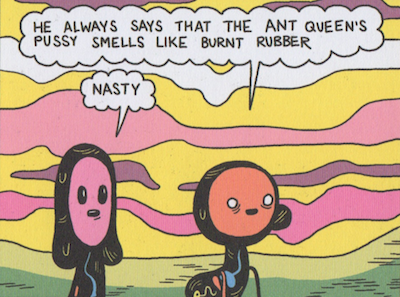
Like a wicked fever dream or a Ralph Bakshi film, Michael DeForge's Ant Colony, published by Drawn & Quarterly, is a comic that manages to be completely otherworldly while at the same time lucid enough to be relatable. Originally published online and fully readable here, DeForge's vision of a colony of ants marching through life (and through the giant ant queen's "sex canal") is a fitting tribute to the unpredictability and fragility of living, portrayed by one of the more twisted graphic artists working today.

The black ants of the story are beautifully drawn, each with their own individual digestive system and unique head and body shape, distinguishing them from their completely identical red ant counterparts. The black ants, who remain mostly nameless, are expected to fulfill their duties for their Queen, but DeForge's main characters are philosophers, frustrated lovers, dubious fathers, and freaked out children who end up on a series of misadventures. As this was originally a webcomic, there is less of a central narrative so much as there is a series of events that culminate in a war between the black ants and the red ants, who are high on the dripping pink milk of the neighbouring wolf spiders, and the collapse of the hive, foretold by a boy ant who, having subdivided a worm into so many microscopic living pieces and inhaled them, gains prophetic powers. Yep, it's a trippy book. It feels slightly disjointed, but there is enough of a link between the stories that you care about the characters and their overall fate within the story.

DeForge Ant Colony Ant Queen's Pussy
This comic is definitely not for kids

The beauty of the desolation DeForge illustrates is in the small details. The colour in the world is hyperreal and rich, further immersing the reader in the bizarre scenarios played out on the page. The landscapes are suitably bleak, yet alive with the population of creatures such as the limousine centipede and the wolf spiders who are basically wolf heads on spider legs. The ant queen herself is a masterpiece; a giantess of a woman with flowing red hair, sitting languorously with legs akimbo with a stream of tiny ants marching between her legs. This is definitely not the classiest comic, but it is pulled off with such sheer audacity and gorgeous art I was hooked from beginning to end. If there's one thing I'm upset with, it's that the ending, which is suitably enigmatic, is quite abrupt and left me instantly wanting more.

I highly recommend you pick up this book, so you too can appreciate the angst of ants:

DeForge Ant Colony Panels

Sunday, 11 May 2014

Performance Review: The Paper Cinema's "The Odyssey"

The Paper Cinema's The Odyssey

As a huge animation and puppetry fan, I can't say enough good things about The Paper Cinema's latest show based on Homer's The Odyssey. Founded in 2004 by Nicholas Rawling, Imogen Charleston and Christopher Reed, The Paper Cinema utilizes paper cutout puppets and wonderful visual tricks of perspective in front of a camera to create animation in real time for the audience. Odysseus is on the hunt; one puppeteer moves the Odysseus puppet in a way that he is both running and panting, as the second puppeteer whirls trees across the camera behind Odysseus creating the sense of movement and speed. The effect is both engrossing and at times unbelievable. Buildings are created through a slow zoom as the puppeteers manipulate pillars and archways in an uncanny manner, and the sea as Odysseus drifts by on a raft is full of movement and energy. It truly must be seen to be believed (watch the trailer below).

The creators adapted the many trials of Odysseus, Telemachus, and Penelope with clear reverence for the source material, but also with a sense of play and anachronistic flair. While the story and visuals mostly reflect those of Ancient Greece, Telemachus takes a soul-searching journey on his motorcycle, while Penelope's suitors are all wolves in immaculate modern day suits getting drunk on champagne. The monsters in this production have real weight, and the puppeteers do a great job creating a sense of danger. Odysseus has to deal with the despondent giantess Calypso, the terrifying jagged cyclops, and even the great god Neptune himself. There are plenty of tender moments as well, such as in a flashback of Odysseus and Penelope sharing an embrace before he leaves for the Trojan war, to their fated reunion a decade later. The battle against the suitors towards the end of the show was poetry in motion.

The immersion I felt while watching the show could not have been achieved without its immaculate music, composed by Christopher Reed, Ed Dowie, Quinta and Matthew Brown (you can listen to and purchase the soundtrack on bandcamp here). The combination of piano, violin, guitar, electronic keyboard and clever use of the saw, lend themselves perfectly to the visuals appearing on screen. From the cheerful 'Rosy-Fingered Dawn,' to the sleazy track 'The Suitors' reflecting the mooching wolfish layabouts sniffing at Penelope's heels, the soundtrack is evocative of the deep emotions of a husband and wife separated by a decade, and the series of travails hampering their reunion. Foley work is used to great effect for sounds such as the waves, and the low rumble of a sleeping cyclops.

This is a show not to be missed. It is currently touring across the UK and Germany.